
By EDDIE PELLS AP National Writer
COLORADO SPRINGS, Colo. (AP) — The bill that passed the Senate this week is called the Protect College Sports Act. If it becomes a law, one of the most important outcomes could be its ability to save Olympic sports in the United States.
A sometimes-overlooked element of the bill designed to regulate name-image-likeness payments and myriad other problems in college sports is the protections it offers the smaller, non-revenue-generating “Olympic” sports. Hundreds of thousands of athletes across the country play these sports in college, and their talent leads to hundreds of medals for the U.S.
Exhibit A: Of the 257 U.S. athletes who won medals at the Paris Olympics two years ago, 184 had roots in an NCAA program.
That’s why, at the urging of the U.S. Olympic and Paralympic Committee, the bill includes language requiring most college programs, which devote the lion’s share of their resources to football and basketball, to maintain the same number of scholarships and roster spots for Olympic sports as they had in the 2024-25 school year.
Another element of the bill adds a $27 million “retention pool” to the revenue-sharing cap schools are allowed to pay to athletes; $5 million of that has to be spent on women’s and Olympic sports.
While not a foolproof solution — some schools could ask for waivers and others could shift numbers around among different sports to dilute their investments — Olympic insiders believe the bill offers a sustainable remedy for what they consider a likely move away from non-revenue sports if schools are left to their own devices.
“The sky is not falling, but we’re not going back to what used to be” whether the bill becomes law or not, Sarah Hirshland, the CEO of the USOPC, said last week at the annual USOPC Assembly. “We’re not in a state of panic about Team USA not being able to compete in Los Angeles. But there are some things that really need to be fixed.”
With House passage uncertain, Olympic leaders study other solutions
Against that backdrop, leaders at the USOPC know that even if the bill passes the House, where it faces a steep climb, they need to plan for a future in which college programs cut Olympic sports to make ends meet.
A report released within the last month by the bill’s co-sponsor, Sen. Maria Cantwell, D-Wash., said that since 2023, which is when the so-called “arms race” to obtain football and basketball talent shifted into high gear, colleges have eliminated more than 100 women’s and Olympic sports programs.
“I feel for the athletic directors because many of them are trying to run a business but they don’t know what tomorrow is, and that makes it really difficult for long-term planning,” said Rocky Harris, the USOPC’s chief of sport and athlete services. “If you can’t do long-term planning, you can’t run a good business. And if they can’t run a good business, then that impacts Olympics sports directly.”
Cantwell has cited the peril Olympic and women’s sports face as the key reason she got involved in crafting the legislation.
The connection between, say, a starting quarterback’s NIL haul and the U.S. gold medal count in LA two years from now exists because the U.S. government, unlike most governments around the globe, doesn’t bankroll the Olympics or its pipeline. That leaves the task to the nation’s grassroots sports organizations and, eventually, the U.S. college system, where football underwrites everything.
“I don’t think people understand the connection between the money that’s made by football and the success of our Olympic system,” said Cody Campbell, the billionaire from Texas Tech who has aired ads during Saturday college football games supporting the legislation.
LA Games should give participation a boost, but will colleges play along?
Harris, who led USA Triathlon before coming to the USOPC, said the push to make women’s triathlon an “emerging sport” at the NCAA level was intended to give young girls a chance “to dream about doing triathlon.”
“Maybe they couldn’t see themselves as Olympians, but many of them could see themselves as a college athlete and I knew that would drive our plan,” Harris said.
Without college programs, Harris says, the potential elite athletes in a sport move on to other things. If those programs do exist that’s how a pipeline begins.
In many ways, the doubts about the future of the Olympic movement come at a time when the United States should be preparing for an upswing in participation with the LA Olympics less than two years away. Hirshland cited numbers that showed participation in some Olympic sports grew between 25% and 35% after the Atlanta Olympics in 1996, the last time the Summer Games were held on U.S. soil.
“I’m still bullish that LA will actually accelerate that,” Hirshland said. “We’re not going to see flat. We’re going to see growth in the desire to do sports some people might have never contemplated.”
But where will the kids who discover fencing or wrestling or track during the LA Games play in college?
The thinking around the USOPC offices is that there will always be programs.
Oregon, for example, has always been a bastion for distance runners and probably won’t do anything to detract from its iconic track program. Iowa’s wrestling program has produced 24 national titles over the years.
What grabs more attention was the move Stanford made in 2020, when, citing financial pressures from the pandemic, it announced it was axing 11 varsity sports. Less than a year later, and under pressure from alumni and boosters, it reversed those decisions.
Still, if a deep-pocketed school like Stanford that had won 25 straight Directors’ Cups — awarded for the overall strongest results across all collegiate sports — could cut programs because of financial pressure, then what school couldn’t? Stanford’s new athletic director, John Donahoe, was recently appointed to the USOPC’s Collegiate Advisory Council, replacing his predecessor on The Farm, Bernard Muir.
Even if the bill passes and schools are required to maintain their numbers, the provision lapses in nine years at the biggest schools and four years at mid-sized universities, which is why the USOPC is doing work now.
Hirshland said she thinks there will be “more customization and differentiation, sport to sport,” based on what makes sense at each university.
“I’d like to believe our education system will remained anchored in sports,” she said. “But if it doesn’t, I’m confident there will be systems that emerge to pick up that demand and provide the experiences for people who want them. Our job is is to drive interest and ensure the infrastructure, and we’re focused on both.”
___
Sign up for Top 25 poll alerts here. Visit the Top 25 here and see AP’s full college football coverage here.
News
How a bill intended to rein in NIL and ‘protect’ college sports could also save the US Olympic team
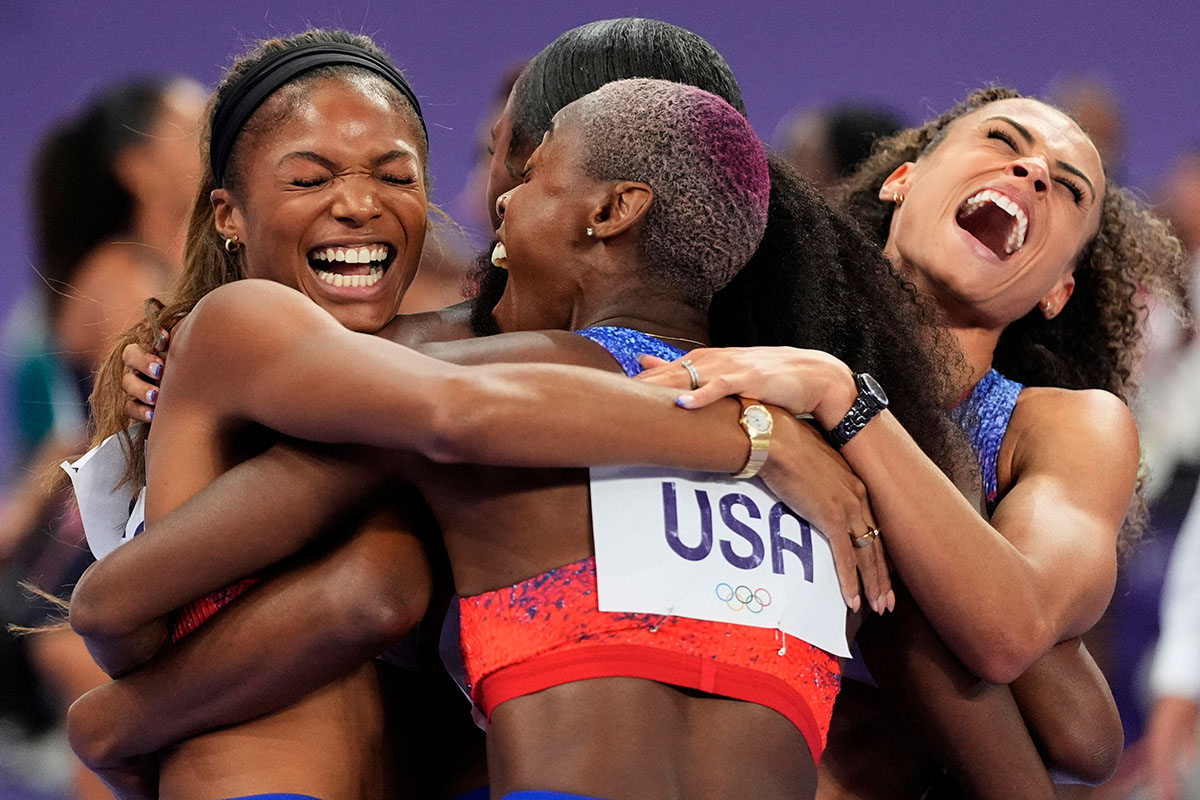
The United States' women 4x400-meter relay team celebrates winning the gold medal at the 2024 Summer Olympics, Aug. 10, 2024, in Saint-Denis, France. (AP Photo/Matthias Schrader, File) Photo: Associated Press